The graph in your analytics used to climb. Now it sags — no crash, just a slow leak, month after month. So you search one of your best queries to see what’s wrong, and there’s the answer: sitting in an AI box at the top of the page, clean and complete, citing a company you’ve never heard of. Your link is down there somewhere. Nobody’s clicking it.
The worst AI SEO mistake you can make in 2026 isn’t a broken setting or a missed keyword. It’s using AI to replace human expertise and editorial judgment. Every penalty, every lost AI Overview citation, every hour of wasted crawl budget traces back to that one decision.
The ten mistakes below are ten symptoms of that one decision, and they share one cure: Put AI underneath human expertise, editorial review, and answer-ready formatting, and the whole category of failure closes at once.
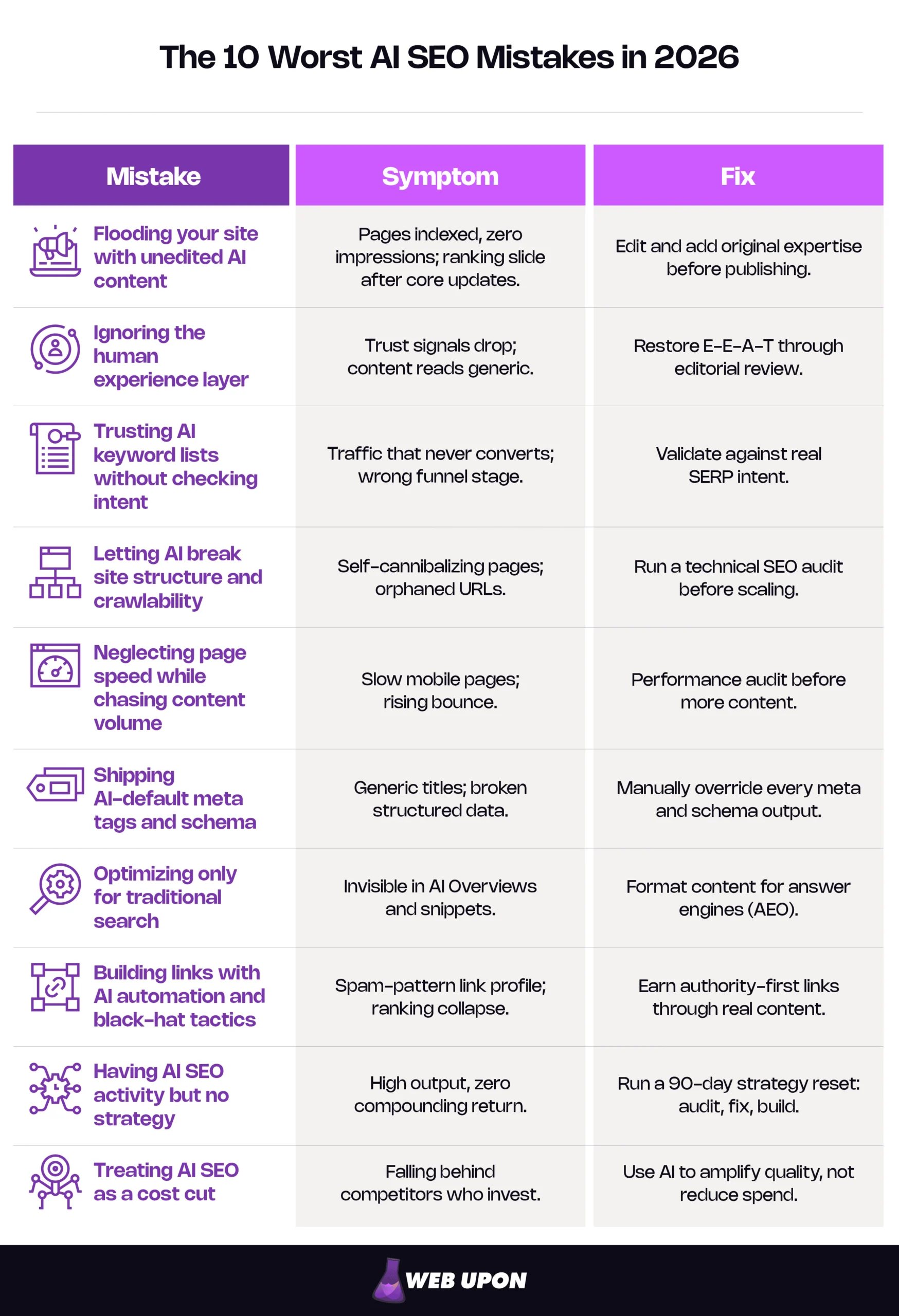
Match the symptoms on your own site. The mistakes cluster in four layers: content quality, technical SEO, Answer Engine Optimization, and strategy.
The Content Quality Mistakes Quietly Destroying Your Search Visibility
Does AI content hurt your SEO in 2026? Not on its own. Google does not penalize content for being AI-generated. It judges whether content is helpful, original, and made for people, not whether a human or a machine wrote it. What gets suppressed is thin, unoriginal, mass-produced “scaled content abuse”, which unedited AI output usually is. AI content that’s edited, fact-checked, and enriched with real expertise can rank perfectly well.
Mistake #1: Flooding Your Site With Unedited, Automated AI Content
The Mistake: Generating pages at volume and publishing them barely edited, on the theory that more pages mean more chances to rank.
Why It Quietly Hurts You: Generative AI used “to generate many pages without adding value” is a textbook example of what Google’s spam policies call “scaled content abuse”. Google folded its “helpful content” system into the core ranking algorithm — there’s “no longer one signal or system” doing this job. Quality is now a constant, site-wide signal, and a heap of thin pages drags down the good ones standing next to it.
Then there’s the quiet tax. Crawl budget is the finite number of pages a search engine will crawl and index on your site in a given window. Flood it with near-duplicate AI pages and you spend that budget on content that will never rank while starving the pages that could.
The Tell: Open your search analytics and look for the fingerprint: dozens of pages indexed, impressions in the low single digits or none. That’s scaled content the algorithm has already, quietly, decided to ignore.
The Fix: Treat every AI draft as a first draft, never a finished page. Before it publishes, someone who actually knows the subject edits for accuracy, cuts the filler, and adds something that exists nowhere else — a real example, a hard-won caveat, a number from your own work, or an original infographic. That last part isn’t a nicety. It’s the literal definition of helpful, people-first content that Google rewards.
Mistake #2: Ignoring the Human Experience Layer That Search Engines Now Reward
The Mistake: Treating “quality” as a grammar problem, while disregarding signals that prove a real expert stood behind the page.
Why It Quietly Hurts You: Search engines reward E-E-A-T — Experience, Expertise, Authoritativeness, Trustworthiness. The first E is the one AI can’t fake: Experience is first-hand, lived knowledge, and a model has none. So when a team hands the whole job to AI, the first things to vanish are exactly the proof points: the named author, the first-person insight, the example that could only come from having done the thing. What’s left reads like someone who has read about the subject, not someone who has worked in it. The distance between AI-assisted and AI-replaced content is precisely the distance the algorithm is built to measure.
| Content Attribute | AI-Assisted Content | AI-Replaced Content |
| Author | Named expert with verifiable credentials | Unattributed or generic byline |
| Insight | First-hand experience, real opinions, hard-won caveats | Consensus available everywhere |
| Examples | Specific, real, sometimes proprietary | Vague or hypothetical |
| AI’s role | Research, structure, first draft | Research through final publish |
| E-E-A-T signal | Strong, hard to copy | Weak, trivially copied |
The Tell: Read a page aloud and ask one question: could a competitor publish this exact paragraph, word for word, without changing a thing? If yes, it’s AI-replaced, and you’ve given the reader no reason to trust you over anyone else.
The Fix: Rebuild the experience layer through editorial review. Attach a credentialed author. Require at least one insight or example that could only come from real experience. Route every AI draft past a human editor before it ships. Web Upon’s content audit and editorial review framework is built for this exact problem — bringing human experience, authoritative expertise, and trustworthy judgment to pages the AI merely drafted.
Mistake #3: Over-Relying on AI Tools for Keyword Research Without Validating Search Intent
The Mistake: Taking an AI keyword list at face value and building pages around it, without checking what people actually want when they search those terms.
Why It Quietly Hurts You: AI keyword tools are strong on volume and pattern and weak on search intent — the real goal behind a query. So they aim content at the wrong stage of the funnel. The classic miss: you answer an informational question (“how does X work”) with a hard-sell landing page. The engine reads the mismatch, the visitor bounces, and you’ve optimized your way to traffic that will never buy. Tell a prompt to maximize keyword density and the oldest sin in SEO — keyword stuffing — walks back in wearing a new outfit, trading relevance for repetition.
The Tell: You rank. You get clicks. Almost nobody converts. That’s rarely a conversion problem on the page; it’s an intent mismatch baked in upstream.
The Fix: Validate every AI keyword against the live results page before you commit a word. Search the term yourself. Look at what’s already ranking — the format, the angle, the funnel stage — and match it. Add the conversational, question-shaped phrasings of voice search that people increasingly speak rather than type. And when you’re sizing a market or mapping a funnel, a real Total Addressable Market (TAM) analysis keeps you aimed at terms that lead to revenue, not just volume.
Content quality is only half the battle. The next mistakes live in the plumbing — the layer most AI tools never flag.
The Technical SEO Traps AI Tools Won’t Warn You About
This is the invisible layer. None of it shows up in a draft you can read, but algorithms read it instantly and judge the whole site by what they find.
Mistake #4: Letting AI Automation Break Your Site Structure and Crawlability
The Mistake: Letting AI auto-generate internal links, publish pages, and rewrite existing content with no one watching the architecture.
Why It Quietly Hurts You: Two failures dominate. A crawlability dead end is a page with no clean path in or out — a room with no doors — so search engines either never find it or can’t place it; AI linking creates these constantly. Cannibalization is when an AI rewrite competes against your own page for the same query, splitting your authority and leaving the algorithm to guess which one you meant to rank. Layer on the structured-data errors AI tools love to introduce, and you broadcast low authority no matter how good the prose is. Algorithms read site structure the way a guest reads a cluttered house: as a signal of how seriously you take the place.
The Tell: Crawl your own site. Orphaned pages (nothing links to them) and several URLs chasing one keyword are the two signatures of AI-driven structural rot.
The Fix: Audit structure before you scale, not after the wreckage. Map internal links on purpose, consolidate the duplicates, and validate every piece of structured data the AI produced. A proper technical SEO audit surfaces the dead ends and cannibalization no content review will ever catch.
Mistake #5: Neglecting Page Speed and Mobile Optimization While Chasing AI Content Volume
The Mistake: Pouring energy into publishing more AI content while the site itself gets slower and clumsier on a phone.
Why It Quietly Hurts You: Scaling content fast hides a paradox: every page you add is more weight on a site whose speed you may be ignoring. Page experience is a confirmed ranking input, as Google states plainly that “Core Web Vitals are used by our ranking systems” as metrics for real-world loading, responsiveness, and visual stability. The current “good” thresholds (taken from the 75th percentile of real visits) are Largest Contentful Paint under 2.5 seconds, Interaction to Next Paint under 200 milliseconds, and Cumulative Layout Shift under 0.1. Think of speed less as a megaphone and more as a tiebreaker: when two pages are close on content and authority, the faster, steadier one wins.
The Tell: Your publishing volume is up and to the right, and so are your mobile load times and bounce rate. That’s content outrunning performance.
The Fix: Audit performance before you scale, then watch the vitals as you grow. Speed is the foundation. Stacking content on a slow site only multiplies the liability. Web Upon’s site speed optimization work keeps performance from quietly capping everything else you do.
Mistake #6: Misconfiguring Meta Tags and Schema Markup With AI-Generated Defaults
The Mistake: Shipping the title tags, meta descriptions, and schema markup — the structured-data labels that tell a search engine what a page is, and make it eligible for rich results and AI citations — exactly as the AI spat them out.
Why It Quietly Hurts You: AI defaults are generic by design. Templated meta descriptions blur your pages together in a crowded results list, and duplicate ones drag down click-through while flagging a thin strategy. Schema is the higher-stakes half. Done right, it’s an asset that qualifies you for featured snippets and AI Overview citations. Done wrong — and AI tools misfire it routinely — broken structured data quietly disqualifies you from the exact rich results you were chasing.
The Tell: Spot-check your indexed pages. Near-identical meta descriptions across different URLs, or structured-data errors flagged in your search console, mean the defaults shipped unsupervised.
The Fix: Override every meta and schema output by hand before publishing. Write descriptions that earn the click and name the page’s specific value; validate the schema so it actually fires. Ten minutes of human attention decides whether a page qualifies for the most valuable real estate in search or sits invisibly outside it.
A technically clean site still loses if it isn’t built for the way people now search: through AI answers.
The Answer Engine Optimization Mistakes Costing You the AI Search Era
Answer Engine Optimization (AEO) means structuring your content so AI answer engines and overviews cite you as the source. Where traditional SEO works to rank a link, AEO works to become the answer through direct, citable responses, question-shaped headings, and clean, extractable summaries.
Mistake #7: Optimizing Exclusively for Traditional Search While AI Overviews Capture Your Traffic
The Mistake: Pouring everything into ranking blue links while an AI Overview answers the question outright — and your traffic never arrives.
Why It Quietly Hurts You: A growing share of searches now end in a zero-click result: the user reads the answer inside an AI Overview and visits no one. Ranking #1 the old way no longer makes you the source the AI quotes. Answer engines reach for the most citable line: a clean, direct answer they can lift and attribute. A page that isn’t formatted for snippets, “People Also Ask,” and AI citation goes unseen no matter how well it ranks. The conversational, question-shaped phrasing these systems favor is exactly what most AI-written content never includes.
| Traditional SEO | Answer Engine Optimization (AEO) |
| Goal: rank the page (the blue link) | Goal: become the source the answer cites |
| Optimizes for keywords and backlinks | Optimizes for direct, citable answers |
| Success = a click to your site | Success = a citation, even without a click |
| Rewards comprehensive pages | Rewards clearly extractable answers |
| Reader scans links, picks one | AI writes the answer, names its sources |
The Tell: Rankings steady, click-through sliding. That gap is usually an AI Overview intercepting the answer a few pixels above your link.
The Fix: Reverse-engineer AEO from the pages you already have. For each priority page: lead with a direct, one- or two-sentence answer to the core question, high up; add a question-shaped H2 that mirrors how people actually ask it; and tighten one short, self-contained summary an AI can lift cleanly. You’re not rewriting the page. You’re making its best answer easy to find and easy to quote, formatted for the machine doing the reading.
Mistake #8: Building Links With AI Automation and Black Hat Practices That Trigger Algorithmic Suppression
The Mistake: Turning AI loose on link building — automated outreach, machine-spun anchor text, bulk low-authority links — to manufacture authority at scale.
Why It Quietly Hurts You: AI link tools are remarkably good at reproducing the exact patterns search algorithms were trained to punish. Automated outreach, spun anchor text, and links from low-authority farms are the textbook signatures of manipulation. AI lets you commit them faster and in greater volume than any human could, which means you trip the spam systems faster too. The speed cuts the wrong way: you’re not building authority faster, you’re sprinting toward suppression.
| Black-Hat Signal (avoid) | Authority-First Alternative (build) |
| Automated mass outreach | Real relationships and earned mentions |
| Spun, over-optimized anchor text | Natural anchors from genuine editorial context |
| Bulk links from low-authority farms | Fewer links from sources that actually carry weight |
| Volume as the goal | Relevance and trust as the goal |
| Trips spam detection | Earns citations, including from AI systems |
Those left-column tactics are listed so you can recognize and refuse them, not run them. The entire point is that they fail.
The Tell: A backlink profile that swelled fast, heavy with low-quality domains and the same exact-match anchor repeated. That’s a suppression risk already sitting on your site.
The Fix: Earn authority instead of automating it. The move that lasts is content genuinely worth citing — original research, real expertise, a resource other sites want to link to. That’s the same profile AI search systems reach for when deciding whom to quote. It isn’t a link tactic; it’s a content strategy, and it’s the only kind of link building that compounds instead of collapsing.
Fixing mistakes one at a time helps — but with no strategy underneath, you’re just making the same error faster. The last cluster pulls back to see the whole board.
The Strategic Mistakes That Make Every Other AI SEO Error Worse
These are the force multipliers — the meta-mistakes that make the previous eight compound against you.
Mistake #9: Having No AI SEO Strategy, Just AI SEO Activity
The Mistake: Running AI tools hard with nothing governing them, mistaking motion for progress.
Why It Quietly Hurts You: Activity without strategy buys you high output and zero compounding return. With no framework tying the pages together, AI production becomes organized invisibility: a lot of content, no coherent authority.
The Tell: Your site is publishing more than ever, but rankings, traffic, and citations are flat or fragmented. You can’t point to a clear topical authority you own.
The Fix: A 90-day AI SEO reset, built on search intent, E-E-A-T, and AEO.
- Days 1–30 — Audit. Inventory every page. Find the thin and cannibalizing content, the crawl dead ends, the intent mismatches, the missing E-E-A-T. Set a baseline so you can measure recovery.
- Days 31–60 — Fix. Prune or rewrite the thin pages, merge the cannibalizing URLs, restore author credentials and first-hand insight, repair structure and schema, and clear the performance issues the audit surfaced.
- Days 61–90 — Build. On a sound foundation, create new content the right way (AI for research and structure, humans for expertise and review) and format it for answer engines from the first draft.
A reset like this is where most teams stall, because it crosses content, technical, and strategy work all at once. If you’d rather not run it alone, Web Upon can help you execute the full reset, audit through build.
Mistake #10: Treating AI SEO as a Cost-Cutting Exercise Instead of a Competitive Positioning Tool
The Mistake: Reaching for AI to spend less on content, rather than to make your content do more.
Why It Quietly Hurts You: Businesses that use AI to cut content investment fall the furthest behind, while the ones who use it to amplify research, structure, and quality widen the gap every quarter. Shortcuts also run up algorithmic debt — the penalty cost of corners cut today, quietly accruing until a future core update calls it in all at once, at the worst possible moment. The mistake was never using AI. It was aiming it at the wrong target: a content factory, when what wins is a search-intelligence layer underneath human expertise.
The Tell: Your content budget dropped when AI arrived, and your competitors’ visibility climbed. Not a coincidence — that’s the gap compounding in real time.
The Fix: Point AI at leverage, not at the budget. Take the time it saves you and spend it on more expertise, deeper research, and sharper review. That one shift is what turns AI from a slow liability into a durable edge.
Avoid These Ten Mistakes With One Operating Principle
Lay the ten mistakes side by side and the pattern gives itself away: they’re the same mistake wearing ten coats. Flooding, ignoring, over-relying, automating, neglecting, cost-cutting — each one is a version of letting AI replace expertise instead of amplifying it. You need one principle, applied everywhere: AI builds the scaffolding; humans bring the expertise, the judgment, and the trust that algorithms and readers reward.
The businesses that win this era won’t be the ones who used AI the most, but those who pointed it in the right direction. You’re not doomed by any of this. The moment you can see these mistakes, you can fix every one. If you want a content audit from people who understand how AI, SEO, and editorial quality work together, reach out to Web Upon.