You are the best-kept secret in your own zip code. Your work is better, your reviews say so, and yet the phone stays quiet while a competitor with half your skill fills their calendar from Google. The problem is not your business. It is your visibility. And fixing it means hiring a local SEO consultant who actually knows what they are doing.
Here is what to look for before you sign anything. In 2026, the right local SEO consultant will demonstrate five things: (1) verified map pack results backed by real case studies, (2) current mastery of Google Business Profile optimization and AI-driven search, (3) a structured methodology that starts with a comprehensive audit, (4) full transparency on KPIs, pricing, and realistic timelines, and (5) a focus on your business goals — not vanity metrics. Miss on any of these, and you are back to hoping the phone rings.
What follows unpacks each criterion with the specific vetting questions, red flags, and pricing context you need to make a confident hiring decision.
Key Takeaways
- The right consultant checks five boxes: verified map pack results, current GBP and AI search mastery, an audit-first methodology, transparent pricing and timelines, and alignment with your actual business goals.
- Google Business Profile is the #1 local ranking factor — category selection, posting cadence, photo optimization, and review velocity are primary inputs for map pack placement.
- AI search is reshaping local discovery, but local queries trigger AI Overviews far less often than informational ones, making traditional map pack visibility and GBP optimization more important than ever.
- Red flags that should end the conversation: guaranteed rankings, instant results promises, black-hat tactics, and vague reporting. Google itself warns that no one can guarantee a #1 ranking.
- Expect realistic timelines: meaningful map pack movement takes three to six months, and competitive dominance requires twelve months or more.
- Pricing models matter more than price points. Monthly retainers suit ongoing optimization; project fees work for discrete needs; performance-based models can misalign incentives.
- You are part of the equation. The businesses that get extraordinary results treat the engagement as a partnership, not a handoff.
What a Local SEO Consultant Actually Does (And Why It Matters in 2026)
A local SEO consultant optimizes your visibility for the searches that drive revenue. When someone in your service area types “emergency plumber near me” or “family dentist in Portland,” the consultant’s job is making sure your business shows up in the map pack — the top three local results Google displays alongside a map — and in the local organic results below it. They manage your Google Business Profile (GBP), your local citations, your on-site content, your review strategy, and the technical foundation that holds it all together.
That has always been the job description. What has changed is the environment around it.
The 2026 Local Search Landscape in 60 Seconds
Three shifts make hiring the right consultant more critical than it was even two years ago.
- AI is rewriting how local results surface. Google’s AI Overviews — AI-generated summary answers at the top of search results — appear far less frequently for local queries than informational ones; an Ahrefs analysis of 146 million searches found AI Overviews on only 7.9% of local queries compared to 22.8% for non-local searches. Still, they are reshaping how businesses get discovered. Google’s AI Mode already pulls directly from GBP data for local queries, making your business profile the front door to AI-driven visibility. A consultant still running a 2023 playbook has not caught up.
- Proximity and hyper-local relevance carry more weight. Google increasingly favors businesses that are close to the searcher and whose content speaks directly to specific neighborhoods and service areas. A single generic “services” page no longer competes against a site built with location-specific depth. Consultants who understand whether local SEO still delivers results in 2026 know how to weave that hyper-local relevance into every layer of your presence.
- GBP has become the single most impactful lever for local visibility. Category selection, attributes, posting cadence, Q&A management, photo optimization, review velocity — these are not nice-to-haves. They are the primary ranking inputs for map pack placement. A consultant who treats GBP as a set-it-and-forget-it profile is working with an outdated playbook.
Why the Right Consultant Makes or Breaks Your Local Visibility
Because local search optimization has become more technical and more dynamic, the distance between a good consultant and a bad one has never been wider. A mediocre hire in 2026 is not just a wasted monthly expense — it is an opportunity cost with a compounding penalty. Every month you are not optimizing correctly, your competitors are pulling further ahead in the map pack. That gap does not wait for you to catch up.
Here is exactly what to evaluate.
The Five Qualities That Separate Great Local SEO Consultants From Expensive Mistakes
When you are ready to hire a local SEO expert, these five qualities are non-negotiable. Each includes what to look for and a specific question you can put to any consultant during a discovery call.
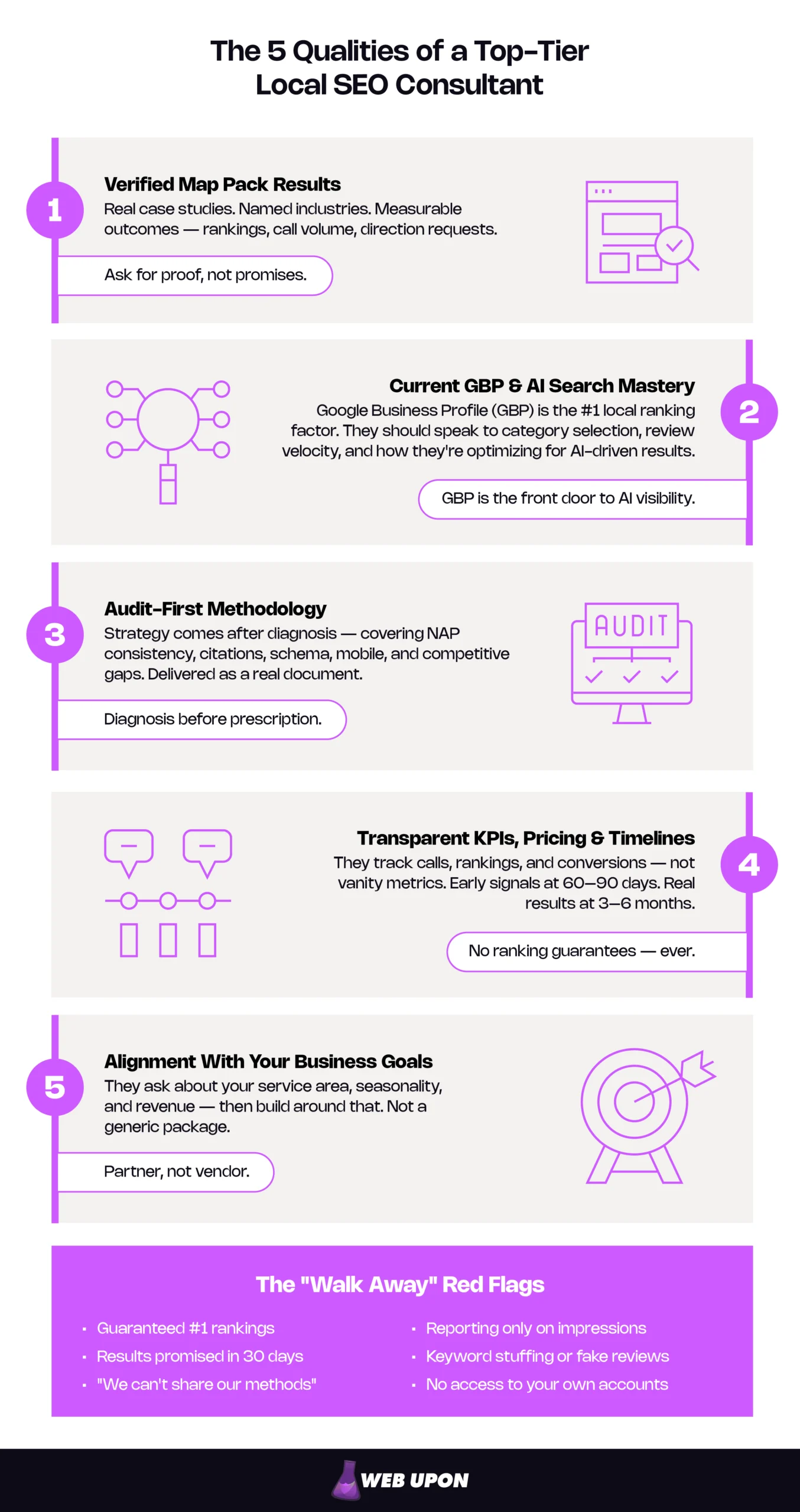
1. Verified Map Pack Results With Real Case Studies
Any consultant can say they “improve local rankings.” The words cost nothing. What separates credible consultants from smooth talkers is evidence you can verify. You want specific examples of businesses they have moved into the map pack — ideally in an industry that looks like yours.
Look for named industries, measurable metrics (ranking improvements, call volume increases, direction request growth), and timelines showing sustained results rather than temporary spikes. A case study that says “we helped a plumbing company rank higher” tells you nothing. One that says “we moved a two-location plumbing company from position 12 to a consistent top-three map pack position over five months, with a 40% increase in calls from Google” tells you everything.
Ask this: “Can you walk me through a local campaign for a business in my industry, including the starting position, what you did, and the measurable outcome?”
2. Current Mastery of Google Business Profile and AI Search
Google Business Profile optimization is the single most impactful lever for local visibility in 2026, and it shows during vetting. A strong consultant will speak fluently about category selection and attribute optimization, posting strategy, Q&A management, review response protocols, and photo and video optimization — not as a checklist they read back to you, but as interconnected levers they know how to pull.
But mastery of GBP alone is no longer sufficient. The consultant should also articulate how they are adapting to AI-driven search — specifically, how they ensure client businesses appear in AI-generated local recommendations. This means understanding how AI systems pull from structured data, how GBP signals feed into AI results, and how content needs to be structured for extraction by language models. A consultant who cannot speak to this is already behind.
Ask this: “How has your GBP strategy changed in the last 12 months, and what are you doing specifically to optimize for AI Overviews?”
3. A Structured Methodology That Starts With an Audit
A credible consultant does not pitch solutions before diagnosing problems. They begin with a comprehensive local SEO audit — a systematic look at where your local presence actually stands before proposing any strategy.
That audit should cover listing accuracy and NAP consistency. NAP — Name, Address, Phone number — is the foundational data that must be identical across every directory and citation. The audit should also evaluate citation health through local citation management, GBP completeness, and website technical health including mobile performance and page speed. It should assess schema markup (structured data that helps search engines understand your business information) and run a competitive gap analysis for your service area.
The deliverable should be a document you can read, understand, and reference — not a sales pitch disguised as analysis.
Ask this: “What does your audit process look like, and what will I receive as a deliverable before we start any optimization work?”
4. Transparent Communication on KPIs, Pricing, and Timelines
The consultant should clearly explain which KPIs they track and why. For local SEO, the metrics that matter are map pack rankings, local organic traffic, phone calls, direction requests, and conversion rates. Not raw impressions. Not generic traffic numbers that look good on a slide but never connect to revenue.
They should also be upfront about reporting cadence, their pricing model and what is included, and realistic timelines. Meaningful movement in map pack rankings typically takes three to six months, with ongoing optimization required for sustained results. Twelve months or more is realistic for competitive dominance. Any consultant who promises faster without qualifying those claims is selling you confidence they cannot back up.
Ask this: “What does your monthly reporting look like, and what should I expect to see at the 90-day mark?”
5. Alignment With Your Business Goals — Not Just SEO Metrics
The best local SEO consultants measure success the way you do — booked jobs, qualified leads, revenue growth — not by metrics that only matter inside a dashboard. Before proposing anything, they should ask about your business model, service area, seasonal patterns, competitive landscape, and growth goals. They want to understand your definition of a good month because that is what they will optimize toward.
A consultant who pitches a generic package without understanding your business is not a strategic partner — they are a vendor running the same playbook for every client. The difference matters most for local businesses, where hyperlocal marketing strategies tailored to your service area dramatically outperform one-size-fits-all approaches.
Ask this: “How do you connect SEO performance to actual business revenue, and how do you tailor your approach to my specific service area and goals?”
| What Great Consultants Do | What Mediocre Consultants Do |
| Show verified case studies with measurable outcomes | Offer vague claims about “improving rankings” |
| Demonstrate current GBP and AI search expertise | Rely on tactics that worked three years ago |
| Start with a comprehensive audit before proposing strategy | Jump straight to a generic proposal |
| Report on business-outcome KPIs with realistic timelines | Report on vanity metrics and promise fast results |
| Tailor strategy to your business model and service area | Pitch the same package to every client |
Knowing what to look for is half the equation. The other half is evaluating how a consultant plans to deliver on it.
Want to see what this looks like in practice? Explore Web Upon’s local SEO approach →
How to Evaluate a Consultant’s Approach Before You Sign
Qualities tell you who a consultant is. Methodology tells you how they work. Here is how to evaluate both during proposals and discovery calls — the moments where you decide whether to move forward.
What a Strong Local SEO Proposal Should Include
A credible proposal or scope of work should contain:
- A preliminary audit summary or gap analysis
- A phased strategy with clear milestones
- Defined deliverables for each phase
- KPIs tied to business outcomes, not just SEO metrics
- A communication and reporting schedule
- Clear pricing with no hidden fees
If the proposal is a one-page generic pitch that could apply to any business in any market, that is a warning sign. A good proposal reflects homework on your specific situation — even at the preliminary stage.
Reputation Management and Review Strategy as a Litmus Test
How a consultant approaches review generation and reputation management reveals whether they think holistically about your local presence or just chase technical metrics. Reviews are both a ranking signal and a trust signal. A strong consultant should have a proactive, ethical review acquisition strategy, a protocol for responding to negative reviews that protects your brand, and an understanding of how review signals — volume, velocity, recency, sentiment — influence local rankings.
Ask about reviews early in the conversation. A consultant who treats them as an afterthought is telling you where customer experience falls on their priority list.
Mobile Performance and Technical SEO: Non-Negotiable Baseline
People increasingly turn to Google on their phones to solve local needs in the moment, from finding nearby services to checking hours and directions, and many decide to call or visit straight from the search results. Mobile is not a feature of local search — it is the medium. Any consultant handling near me search optimization in 2026 must treat mobile experience as a baseline, not a differentiator.
The consultant should address mobile-first website performance, page speed optimization, local schema markup (LocalBusiness schema, review schema), and Core Web Vitals compliance — Google’s metrics for page loading speed, interactivity, and visual stability. If a consultant does not mention these during the discovery conversation, they are behind.
These are table-stakes. Do not award extra credit for them — just disqualify anyone who skips them.
Red Flags That Should End the Conversation
Not every warning sign requires detective work. Some consultants tell you who they are in the first conversation — if you know what to listen for.
| Red Flag | What It Usually Means |
| “We guarantee #1 rankings” | They are either dishonest or using manipulative tactics that will backfire. |
| “Results in 30 days” | They do not understand how local search algorithms work. |
| “We can’t share our methods” | They are using tactics they know would concern you. |
| “We manage everything — no need for access” | They want to control your accounts so leaving is difficult. |
| Reporting only on impressions and raw clicks | They cannot connect their work to your actual business results. |
Guaranteed Rankings and Instant Results Promises
No consultant can guarantee specific rankings — Google itself states this explicitly in its Search Central documentation. Google’s algorithm weighs hundreds of signals, and no one outside Google controls how they interact. A promise of “#1 in 30 days” is either a lie or a shortcut that will eventually backfire as a penalty. Realistic consultants talk about probability, competitive dynamics, and timelines. They earn your confidence — they do not manufacture it.
Black-Hat Tactics and Outdated Playbooks
Watch for keyword stuffing in GBP descriptions, fake review schemes, link buying, and any strategy that sounds like it is trying to trick the algorithm rather than earn visibility. Google’s August 2025 spam update specifically targeted these manipulative local SEO tactics, improving detection of business name stuffing, inauthentic review patterns, and fake location listings. These tactics create short-term illusions that collapse when Google catches up.
Equally concerning: a consultant whose approach has not evolved. If their local SEO strategy still revolves around directory submissions and exact-match anchor text without addressing AI search or current algorithm priorities, they are selling you a service frozen in 2021.
Ask this to test for adaptation: “What has changed in your approach in the last 12 months?”
Vague Reporting and Hidden Pricing
If a consultant cannot clearly explain what you will pay, what you will receive, and how progress will be measured, that is a transparency problem. Other warning signs: refusing to share access to your analytics or GBP accounts, reporting only on vanity metrics, and pricing structures designed to lock you into long contracts without performance accountability.
Your data is your data. Any consultant who resists giving you full access to your own accounts is prioritizing their leverage over your best interest.
If you are ready to work with a team that operates with full transparency, let’s start a conversation →
Now you know what to avoid. The next question is what the right engagement costs — and how to tell whether you are paying for results or for a retainer.
Understanding Local SEO Pricing Models and What to Expect to Invest
Local SEO pricing varies widely by market, competition, and scope. Rather than fixating on a number, focus on the model and whether the scope justifies the cost.
Retainers, Project Fees, and Performance-Based Models
Three pricing structures are most common in local SEO services:
| Model | Best For | Key Question to Ask |
| Monthly Retainer | Ongoing optimization, consistent local visibility, most common for local SEO | “What specific deliverables are included each month, and what happens if I cancel?” |
| Project-Based Fee | One-time engagements like audits, GBP setup, or migration support | “What is the defined scope, and what constitutes completion?” |
| Performance-Based | Businesses wanting to tie fees directly to results — less common and harder to structure fairly | “How are ‘results’ defined, and who controls the measurement?” |
Monthly retainers are the most common model for local SEO because the work never finishes — rankings require maintenance, content needs refreshing, reviews need managing, and algorithm changes demand adaptation. Project-based fees make sense for discrete needs with clear endpoints. Performance-based models sound appealing in theory, but they can quietly incentivize a consultant to chase the metrics that trigger their bonus rather than the outcomes that grow your business. Read the terms carefully.
Calculating ROI: The Cost of Doing Nothing vs. Investing in Expertise
The real question is not “how much does local SEO cost?” It is “what does invisibility cost?”
Think about what a single new customer is actually worth. A plumber’s emergency call might bill a few hundred dollars — but the customer who trusts you with the emergency becomes the customer who calls you for the renovation. That relationship is worth thousands. A dentist’s new patient from a local search represents years of appointments. An attorney’s single qualified lead from the map pack can justify an entire quarter of consulting fees.
Every month you are not visible in local search, those customers walk into your competitor’s door instead. Local SEO for small business is not an expense line — it is a revenue multiplier that compounds. Better rankings lead to more reviews, which lead to better rankings, which lead to more calls. The flywheel only spins if someone builds it.
The cheapest consultant is rarely the best value. The most expensive one is not automatically the best either. The right investment matches your goals with sound methodology and a demonstrated track record.
You know what to look for, what to avoid, and what to invest. The final piece is making sure the engagement actually works once it starts.
Building a Partnership That Actually Delivers Results
Signing the contract is not the finish line. It is the starting line. How you structure the partnership from day one determines whether the engagement delivers.
Setting Clear Goals and Realistic Expectations From Day One
Before the work begins, align on specific business objectives — not just SEO metrics. Define what “success” looks like at 90 days, six months, and twelve months. Agree on communication cadence and reporting format. Local SEO is an ongoing investment: meaningful traction typically takes three to six months, and competitive dominance requires twelve months or more.
How long does local SEO take to show results? Expect early indicators — improved GBP engagement, initial ranking movement — within the first 60 to 90 days. Meaningful lead generation improvements typically arrive between months three and six. The businesses that commit to twelve months of consistent optimization are the ones that eventually dominate their local markets, because a well-executed local SEO strategy compounds over time.
Your Role in the Partnership: What the Consultant Needs From You
A good consultant cannot succeed in a vacuum. That means providing timely access to your GBP, website, and analytics accounts, and responding promptly to requests for service descriptions, photos, and customer testimonials. It also means actively participating in review generation and committing to regular check-ins so the strategy stays aligned as your business evolves.
The businesses that get extraordinary results from their consultants are not the ones who hand off the work and disappear. They are the ones who treat the engagement as a partnership — because that is exactly what it is.
Your Local SEO Consultant Hiring Checklist
The Quick-Reference Evaluation Framework
Use this checklist when evaluating any local SEO consultant or proposal:
- Verified results — Can they show case studies with measurable outcomes in your industry or a similar one?
- GBP and AI search mastery — Do they demonstrate current expertise in Google Business Profile optimization and AI search adaptation?
- Audit-first methodology — Do they start with a comprehensive audit before proposing strategy?
- Transparent communication and pricing — Can they clearly explain their KPIs, reporting cadence, pricing model, and realistic timelines?
- Business-goal alignment — Do they tailor their approach to your specific business model, service area, and revenue objectives?
- Clean reputation management approach — Do they have an ethical, proactive review strategy?
- Mobile and technical baseline — Do they address mobile performance, schema markup, and Core Web Vitals as non-negotiable foundations?
- Absence of red flags — No ranking guarantees, no black-hat tactics, no vague pricing, no resistance to sharing account access.
A consultant who checks every box is a serious partner. One who misses more than one is a risk you do not need to take.
Ready to Find a Local SEO Partner Who Checks Every Box?
You came here to figure out how to separate the real experts from the expensive mistakes — and now you have the framework to do it. Five qualities to demand, red flags that end the conversation, pricing models that make sense, and a partnership structure that turns strategy into results. The businesses that win in local search are not the ones with the biggest budgets. They are the ones who ask the right questions, set the right expectations, and commit to the long game.
Web Upon’s local SEO approach is built around the criteria we have covered — audit-first methodology, transparent reporting, GBP mastery, and strategy anchored to your business goals. If you want to see how it measures up against your new checklist, schedule a consultation with our local SEO team or explore our local SEO services.