The graph you’ve watched climb for years is about to drop. You’re moving to a new domain, you click submit on the Change of Address tool, and somewhere in your gut a question sits there: did I just throw away everything I built?
A domain migration is one of the highest-stakes moves in SEO, but it isn’t a coin flip. Google runs a defined process for site moves, your authority is designed to travel through it, and the post-move dip you’re bracing for is almost always a phase, not a funeral. This guide trades that fear for two things you can actually use: a timeline you can plan around, and a protocol you can hand to whoever is doing the work.
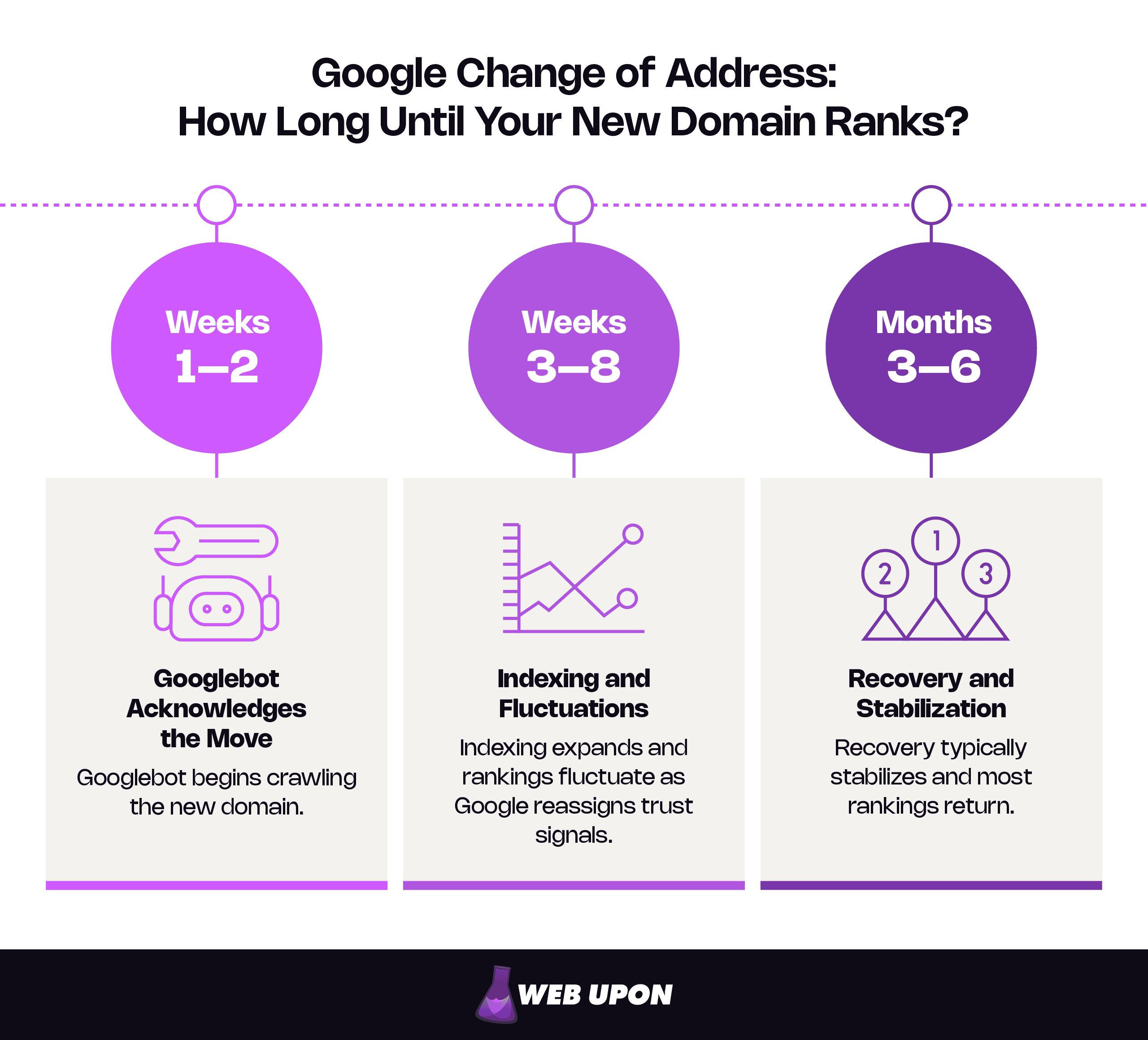
Googlebot usually acknowledges the move within 1–2 weeks, rankings fluctuate through roughly weeks 3–8, and recovery generally stabilizes around 3–6 months. With 301 redirects live and Google Change of Address submitted correctly, a clean migration recovers the large majority of rankings. Gaps that linger past six months trace back to content, backlinks, or technical errors — not the Change of Address tool, and not the decision to move.
Key Takeaways
- The early dip is normal. Visibility may fluctuate temporarily during a move and rankings settle over time.
- The Google Change of Address tool does not replace your 301 redirects. They’re partners: the tool announces the move, the redirects carry users and link equity.
- The single most expensive mistake is submitting the Change of Address tool before the 301 redirects are live.
- What actually drives recovery speed is accumulated backlink strength and earned trust, not the destination domain’s age.
- Two numbers, kept separate: the Google Change of Address tool’s relationship window is 180 days, while Google recommends keeping redirects live at least 1 year.
Understanding the Ranking Timeline: Why the Hidden Clock Starts Before You Submit Google Change of Address
Most people think the clock starts when they click “submit.” It doesn’t. The tool is a signal — an announcement that your site has a new home — but crawling, indexing, and ranking recovery each keep their own time, largely indifferent to the moment you press the button. Learn those separate clocks and you can tell a normal dip apart from a real problem. That single skill is what keeps you calm for the next six months.
Why the 1–2 Week Crawl Window Is Just the Beginning
The “1–2 weeks” figure everyone quotes describes when Googlebot starts acknowledging the move. Not when rankings stabilize. It’s the gun going off, not the finish line, and the panic almost always comes from collapsing three separate phases into one and expecting them to resolve together.
Three clocks are running, not just one:
| Phase | What’s happening | Typical timeframe |
| Crawl acknowledgment | Googlebot discovers the redirects and follows them to the new domain. | ~1–2 weeks |
| Index updating | New URLs replace old ones in Google’s index; old URLs drop out. | Several weeks |
| Ranking recovery | Authority and trust signals are reassigned; positions re-settle. | ~3–6 months |
The dip you’ll see across weeks one through eight is the index updating, not your rankings failing. Recalibration, not damage.
The Algorithmic Latency Factor Most Migrations Ignore
Here’s the variable that ambushes even careful migrations: algorithmic latency — the lag between Google processing your 301 redirects and actually reassigning the ranking signals attached to your old URLs.
Picture mail forwarding. The day you file, the post office knows. But your magazines, your bank, the friend who only writes at the holidays — they each update on their own schedule, and for weeks some mail still lands at the old address first. Your authority moves the same way. The redirect tells Google where everything went; consolidating all that link equity onto the new domain takes time to ripple outward. Across real migrations, that consolidation tends to run its course over three to six months.
A domain that already carries backlinks and earned trust soaks up transferred authority faster than one starting cold. The edge comes from those accumulated signals, not the domain’s age itself. When SEOs say “domain authority,” it means the strength of your backlink profile and accumulated trust, not an official Google metric. It’s a useful idea, not a dial inside Search Console.
How 301 Redirects Work Alongside Google Change of Address
This is the one to get right: the Change of Address tool does not replace your 301 redirects. They’re partners, not substitutes. The tool tells Google the move is intentional; the 301 redirects physically carry users and link equity from each old URL to its new home.
Now the line that the “SEO suicide” fear needs to hear: 301 redirects don’t lose PageRank. The equity is built to transfer. Your only job is to keep the redirects clean enough for Google to follow without friction.
Friction is where migrations quietly die:
| Misconfiguration | Symptom | Fix |
| Redirect chain (A → B → C → D) | Slow crawling, wasted crawl budget, delayed indexing. | Send each old URL straight to its final home. |
| Redirect loop (A → B → A) | Pages never resolve; bots and users hit a wall. | Break the circular rule so every URL resolves exactly once. |
| Missing DNS / broken records | New domain unreachable; the crawl stalls. | Confirm DNS has propagated and the server is stable before you submit. |
Don’t funnel a pile of old URLs to the homepage. Google may read that as a soft 404, and the equity those pages carried evaporates. Map each meaningful URL to its closest new match, then use the URL Inspection Tool to confirm those redirects are being crawled and indexed on the new domain.
Understanding the clock is half the job. Executing the move without tripping it is the other half.
Executing the Migration Protocol: Moving Domains Without Losing Authority
A migration lives or dies on order of operations. Google’s own sequence leaves no room for interpretation: prepare the new site, map the URLs, switch on the redirects, then submit the Change of Address. Run those steps out of order and you manufacture the exact traffic loss you set out to avoid.
Pre-Migration Assessment: What to Audit Before You Touch the Tool
Before anyone opens the Change of Address tool, four things have to be true:
- Run a full backlink audit. Find the URLs other sites actually link to. Those are the pages that must be individually mapped to a 301. Losing the redirect on one high-authority page hurts more than losing it on fifty quiet ones.
- Weigh the destination domain’s strength. A weaker or brand-new destination absorbs transferred equity more slowly. Knowing that now sets an honest recovery curve later.
- Check DNS, server config, and downtime risk. Right after a move, Google crawls your new site harder than usual — old-site crawls get redirected on top of normal crawling. Make sure the new server can take the surge.
- Capture a Search Console baseline. Record today’s rankings, impressions, and clicks. That’s the benchmark you’ll measure recovery against. Skip it and “are we recovering?” becomes a shrug.
Learn more about what a domain change involves, Google site migration best practices, and domain migration SEO as a discipline.
Submitting Google Change of Address Correctly
With redirects live and tested, submission is simple if you hold the sequence. Order is the whole game.
- Verify both properties. The old (source) and new (destination) domains must be verified in the same Search Console account. Until both read “Verified Owner,” the tool stays locked.
- Confirm your 301s are live and correct. The non-negotiable prerequisite. Test priority URLs with the URL Inspection Tool first.
- Submit the Change of Address from the old site’s property.
- Confirm acceptance. Once accepted, both properties show a “move in progress” notification. You’ll see it for roughly 180 days — the window in which Google actively maintains the link between the two domains.
The single most expensive mistake in a domain migration is submitting the tool before the 301 redirects are live. Google’s own pre-work lists implementing the redirect first, and the tool runs a quick check for 301s before it sends the move request. It’s the most common horror story in the category, and it’s entirely preventable.
The 180-day notification window is how long the tool keeps the old↔new relationship alive. After that, Google stops recognizing a connection and treats the old domain as a stranger. The redirects should stay live much longer — Google’s explicit recommendation is at least a year, ideally until traffic to the old URLs has genuinely dried up. The 180 days is about the tool, not your redirects. (Teams usually keep paying for the old domain for a year or more anyway, if only to stop someone else from grabbing it.)
Post-Migration Monitoring: Reading the Signals Without Panicking
The move is done. Here’s the part that tests your nerve. You’ll almost certainly see traffic dip in the first two to four weeks, and you’re allowed to expect it. The skill is knowing which signals shrug off and which ones warrant a response.
Stand up parallel Search Console properties for both domains and watch crawl activity, indexing, and rankings on both sides at once. As the move proceeds, indexed pages should fall on the old domain and rise on the new one. That crossover is the migration. (You may see “redirect” warnings on the old sitemap too — ignore them; Google says those are normal during a move.)
Read the dashboard like this:
| Metric | What healthy looks like | Red flag |
| Crawl frequency (new domain) | Steady or climbing as Googlebot finds redirected URLs | Flat or near-zero weeks after submission |
| Index coverage | New URLs rising, old URLs gradually dropping out | New URLs stuck unindexed, persistent crawl errors |
| Rankings | A dip across weeks 1–8, then a recovery trend | No recovery trend at all by month 3–4 |
| Backlink attribution | Links increasingly credited to the new domain | High-value links still tied only to the old one |
Spot-check your highest-priority pages with the URL Inspection Tool to confirm they’re indexed on the new domain inside the expected window. If crawl frequency looks healthy and coverage is trending the right way, a temporary ranking dip isn’t an emergency. It’s the calendar, doing what calendars do.
The move is executed and monitored. The last question is what “recovered” actually looks like, and when.
Setting Realistic Expectations: The Recovery Roadmap to Long-Term Ranking Success
This is the layer you bring to the room when leadership asks, “are we okay?” Ranking recovery after a domain change is a curve, not a switch, and the curve is more predictable than the anxiety around it suggests.
Building a Realistic Ranking Timeline Framework
| Timeframe | What Google is doing | What you’ll see in your data | What to do |
| Week 1–2 | Acknowledges the move; crawls the new domain via your 301s. | First crawl activity on the new property. | Confirm redirects resolve; touch nothing. |
| Week 3–8 | Expands coverage; reassigns trust and authority. | Rankings fluctuate, often sharply; traffic dips. | Monitor, don’t panic; verify priority pages. |
| Month 3–6 | Completes most link-equity transfer; recovery stabilizes; any sandbox effect lifts. | Rankings re-settle toward — often back to — pre-move levels. | Compare against baseline; close gaps. |
| Beyond 6 months | Move is effectively done in the index. | Residual gaps, if any, are isolated. | Investigate content, backlinks, or technical errors. |
Notice the bookends: this roadmap closes on the same timeline the Quick Answer opened with. That’s on purpose — the reassuring math at the top is the reassuring math at the bottom. And a caveat worth keeping: Google itself only commits to “a few weeks for most pages to move” and “rankings settle over time.” The three-to-six-month figure is the observed pattern across real migrations, not a promise. The observed range is genuinely wide, from a few weeks to well over a year depending on site size and backlink depth. Treat every specific date as a planning estimate, never a guarantee.
Why Domain Strength and Backlink Profile Determine Recovery Speed
Two sites can run identical migrations and recover at different speeds. The split usually comes down to the backlink profile and the destination’s history.
Levers that speed recovery up:
- A strong pre-migration backlink profile — more authority to redistribute means a fuller, faster return.
- Destination backlink strength and earned trust — domains that already carry authority absorb transferred PageRank more efficiently. It’s the accumulated signals doing the work, not the domain’s age.
- Building new links to the destination during the move, which signals vitality and reinforces the shift.
The lever that drags it down:
- Backlinks left pointing at the old domain. Redirects forward that equity, but a redirect is an extra hop and isn’t guaranteed forever. Updating high-value external links to hit the new domain directly closes a gap that otherwise never quite shuts. This is the same list from your pre-migration audit; the URLs you mapped for redirects are the link owners worth emailing now.
The Success Checklist: How to Confirm Your Migration Worked
Use this to call the move genuinely done, not just submitted.
- Every high-priority URL is indexed on the new domain, with no duplicate-content signals trailing from the old one.
- Search Console shows zero critical errors — no redirect failures, crawl errors, or DNS issues on the new property.
- Pre- vs. post-migration rankings are compared across target keywords, so recovery is quantified and gaps are named.
- A 6-month monitoring cadence is running in Search Console and analytics, catching delayed suppression before it compounds.
- Redirects stay live (at least a year) and the old domain stays registered.
Clear all five and you haven’t just survived the move. You’ve proven it worked.
A domain migration runs a predictable arc: Google crawls the new site within a week or two, rankings wobble through weeks three to eight, and recovery generally stabilizes by month three to six. Handled with discipline — clean redirects, correct order of operations, patient monitoring — a move carries your authority across intact. High-stakes isn’t the same as high-risk; not when someone who’s watched this curve before is steering. For experienced support through your migration, reach out to Web Upon.